
Operations managers often have to deal with different vehicles in the workplace that are used for different purposes. These include roadworthy vehicles such as employees’ and visitors’ cars, delivery vans and trucks, but also special vehicles such as forklifts, reach trucks, telehandlers, dump trucks and side loaders.
Transport is essential for companies, but can also be very dangerous. In 2021, according to Eurostat (European statistics on accidents at work), 3,347 people across the EU were fatally injured during their working hours. Part of this is due to accidents in the transport of goods.
What are the risks?
Occupational accidents during transport can be divided into four main areas.
- Collisions between people and moving vehicles
- People who fall while loading or unloading vehicles
- Vehicles that fall over due to excessive speed, uneven surfaces or inadequately secured loads
- Personal injury caused by objects falling from the vehicle
But collisions with vehicles can lead to more than just deaths and injuries. They also cause significant material damage, for example to other vehicles, buildings or warehouses, as well as systems and equipment.
Diverse aspects
Every company is different and the differences are diverse: type of company, usual activities, vehicles, employees, visitors, suppliers and much more. Therefore, numerous aspects need to be taken into account when controlling risks posed by moving vehicles. This article focuses on internal traffic routes where pedestrians, cyclists and motorized or electric vehicles meet.
What are the risks?
- There is no separation between walking and driving paths.
- Pedestrians and cyclists are overlooked
- Vehicles move backwards
- Autonomous transport systems are ignored by pedestrians and cyclists
- Company regulations are not adhered to or enforced
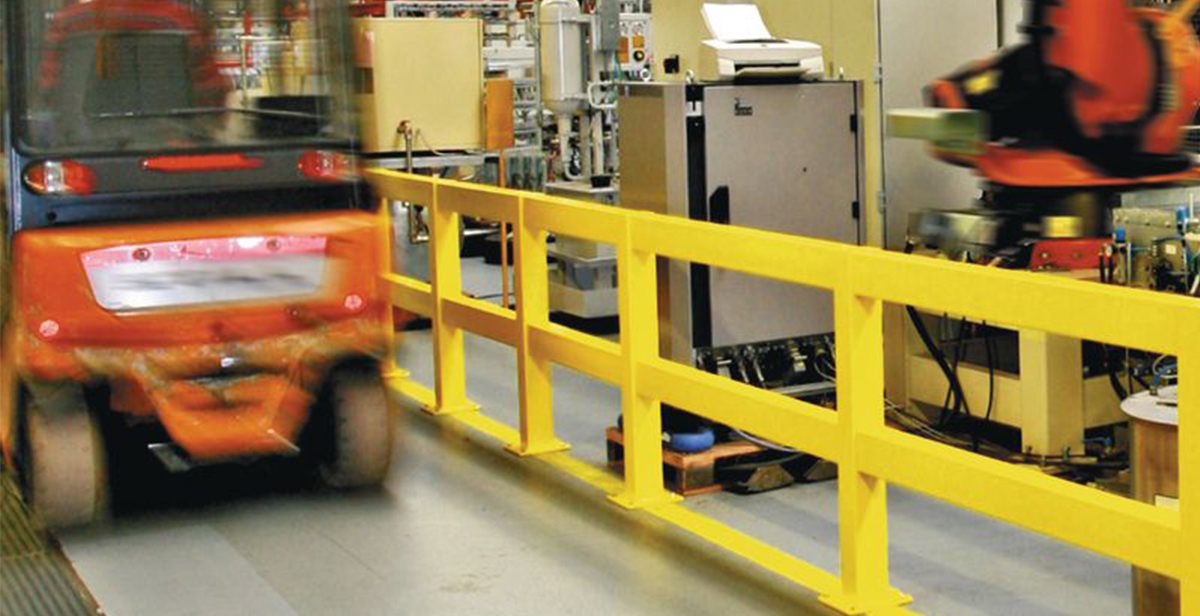
Separating pedestrians and vehicles
Entrepreneurs are responsible for safety in company traffic. According to ASR A1.8, roadways and footpaths must be separated from each other. An optical separation is sufficient for this. However, a physical barrier is preferable if possible. If separation is not possible, appropriate warnings must be provided. Cyclists are also at risk and must be taken into account accordingly
A stable impact protection railing on driveways reliably protects pedestrians and people working nearby from vehicle collisions. The railings should be installed in such a way that pedestrians do not walk onto the road or cross it in particularly dangerous places.
If no barriers can be set up, the driveways can be separated from the footpaths using colored floor markings. The difference in height on a sidewalk with a curb clearly shows the difference between a sidewalk and a driveway. When pedestrian paths follow the natural path, people are more likely to stay on that path. There should be safe pedestrian crossings at intersections between walking and driving paths that are appropriately marked and signposted. For example, different colors or paving can be used to guide pedestrians.
On larger company premises, pedestrian bridges and underpasses can be set up so that pedestrians do not have to cross roads. The bridges must be high enough and secured with height limiters and signs indicating the maximum clearance height so as not to pose a risk for high loads. If the road has to be crossed by numerous pedestrians at a certain time, e.g. B. during a shift change, vehicle access to the road should be restricted.
Poor visibility
Many accidents are caused by poor visibility. Either pedestrians see the vehicles in time or drivers overlook pedestrians and cyclists. There are several reasons for the latter case: e.g. blind spots, poor lighting, confusing entrances and exits or driving speeds that are too high.
Potential dangers, such as road intersections, pedestrians, cyclists and obstacles, must be clearly visible and recognized in a timely manner. Therefore, everyone who is on company premises should wear high-visibility clothing. Obstacles are provided with warning markings or cordoned off. Clear, well-signposted traffic routing with road markings reduces the risk of accidents. In confusing corners, you can use traffic mirrors to ensure you have the right overview.
Certain characteristics of vehicles can severely limit visibility. Some areas are difficult to see, especially in large vehicles. When changing direction, drivers may not be able to see what is in their blind spot, and visibility is particularly lacking when reversing.
Reversing
Almost a quarter of all fatal workplace accidents involving vehicles occur when reversing. In addition, such accidents cause expensive damage to vehicles, equipment and buildings. It is advisable to set up traffic routes in companies so that vehicles do not drive backwards and do not have to maneuver as much. One-way streets or loading and unloading stations where vehicles can pass would be ideal. If reversing cannot be avoided, the following precautionary measures must be taken:
- Maneuvering zones should be designed to ensure optimal visibility for drivers and pedestrians. In addition, these areas must be clearly marked.
- For such areas, block pedestrian passage and access to unauthorized persons.
- In limited visibility, blind spots and confined spaces, drivers should have another person assist them with signals or other cues when reversing.
- Many trucks can be equipped with cameras to help the driver maneuver and detect people around the vehicle.
- Proximity sensors are helpful, but sometimes cause drivers to rely too much on driver assistance systems and become lax in paying attention.
- Vehicles can be equipped with audible backup warnings and flashing lights to alert you that a vehicle is in motion.
- Everyone in the area should wear high-visibility clothing such as high-visibility vests.
Company regulations
If employees do not know or properly understand company regulations and compliance with the regulations is not enforced, accidents can result. For example, when vehicles drive too fast, leave the designated lanes or when people cross the lane in the wrong places.
Drivers and pedestrians who work in the company must know about the traffic routes and the transport-specific systems and rules. New employees must be informed about the company traffic rules during their induction. It must also be ensured that visitors and especially external drivers know the company rules. Speed limits should be posted at entrances and on company premises. Also use directional arrows and StVO signs to ensure traffic safety in your company.
SETON is your provider of security products for operational traffic routes:
» SETON warehouse and shipping
Trade online with pocket option download – a trusted platform with low entry requirements. Start with as little as £1, access over 100 global assets including GBP/USD, FTSE 100 and crypto. Fast payouts, user-friendly interface, and welcome bonuses for new traders.